

Being an entrepreneur is an exciting venture for many people. The thrill of coming up with an idea, business, or product that could be considered unique, original, and “first-to-market” are a few of the many aspirations entrepreneurs have. Perhaps, though, the biggest positive point of being an up and coming entrepreneur is the flexibility to work in an environment that you feel fits best with your style and creativity. However, choosing that location can be a difficult task.
Advantages of a home office
If you are deciding between a home office versus a coworking space, there are just a few pros to working from home. Perhaps the biggest and the cheapest reason is that it’s “free” to work from home. You don’t have to pay another fee to work in a coworking space when you decide to work from home. Another positive effect of the home office is the lack of a commute to get to work. It’s frequently cited that one of the people’s favorite things when working from home is the lack of a commute. The capability to get out of bed 10 minutes before you log on and officially begin your workday is enticing for many young freelancers.
Disadvantages of working in a home office
Working from home might not be ideal if your business requires you to meet with clients on a regular basis. For professional meetings you will constantly need to find different venues or locations, where you can hold these meetings. In a coworking space, there are often conference and meeting rooms readily available to host meetings and clients, thus providing an image of professionalism. According to Buffer’s Report on Remote Work, the 5 biggest struggles remote workers say they face are:
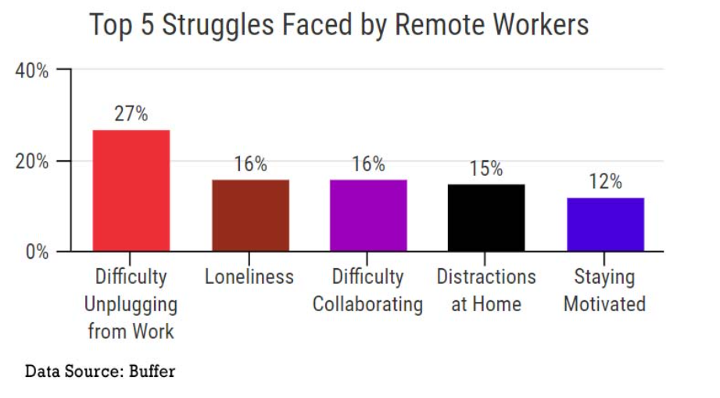
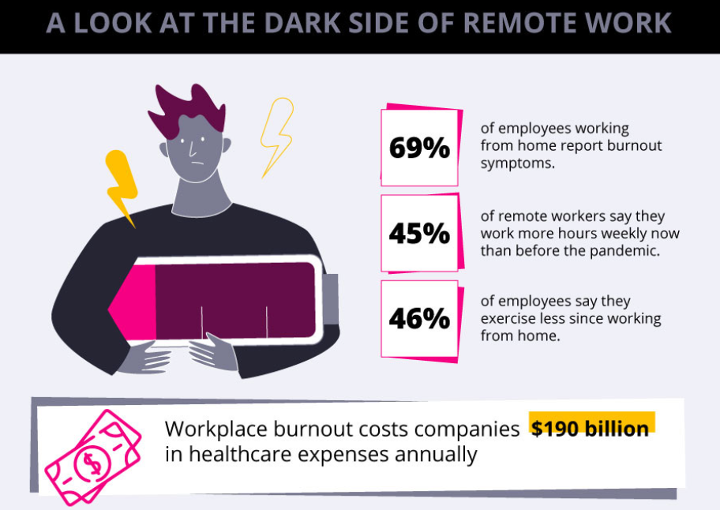
Many of these challenges are unique to a remote work environment. With a lack of proper guidance from HR and management, many employees feel overwhelmed. This is why despite feeling happier, work burnout can actually be more prevalent amongst remote employees compared to their onsite colleagues.
The biggest struggle working in a home office is the difficulty of unplugging from work: Remote workers are 1.27 more likely to struggle to disconnect from work compared to workers that go into the office. Many remote workers suffer from an “always on” mindset when it comes to work, especially with the home office now always accessible. The boundary between when work stops and their personal life begins are often blurred. In addition, in a lot of cases managers often message remote employees even during off hours via email and text, which makes it even more difficult to concentrate on their personal life.
Lack of Social Support/ Loneliness: In a survey of 1,000 professionals, 76% say “lack of social interaction” was what they disliked most about working from home. Since the pandemic employees are 3x more likely to report poor mental health compared to before, revealed by Flexjobs in a study. A big part of the issue is social isolation. In the past it was easy to have a small conversation with any of your colleagues or to have a good laugh with your teammates during lunch, remote working has changed all of that. The lack of in-person interaction over time can lead to a loss of motivation, increased stress, and even depression according to experts.
Virtual Overload: According to Owllabs, Employees are attending 50% more video meetings since the pandemic. As a consequence, 49% of professionals surveyed say they suffer from “Zoom Fatigue”.
Frequent Distractions: When you’re working remotely and with no supervision, it’s a lot easier to get distracted. There are plenty of things to distract you if you’re working from home: different noises in the home environment, dog barking or the presence of the family. Apart from juggling family life, the temptation to lie down, watch TV, or play games is always there. These distractions can sideline a remote worker, creating frustration and leading to burnout as one tries to play catchup with his work.
Advantages of a coworking environment
Working in a coworking space can be an excellent option for professionals, freelancers, start-ups and creatives. They often provide people with a chance to network with other individuals who are in the same type of career field as them. They also have the opportunity to interact and socialize with others on a daily basis that can lead to motivation, creativity and productivity improvement. Apart from the social aspect, many people join coworking spaces to gain new business connections. 82% of surveyed members say coworking has expanded their professional networks. Moreover, 51% of coworking space members feel that joining has helped them in finding new job opportunities.

According to a GCUC survey, 84% of coworkers say working in a coworking space makes them more engaged and motivated. 69% surveyed say they have acquired news skills, and 68% say they have improved their existing skill set as a result of working in coworking spaces.
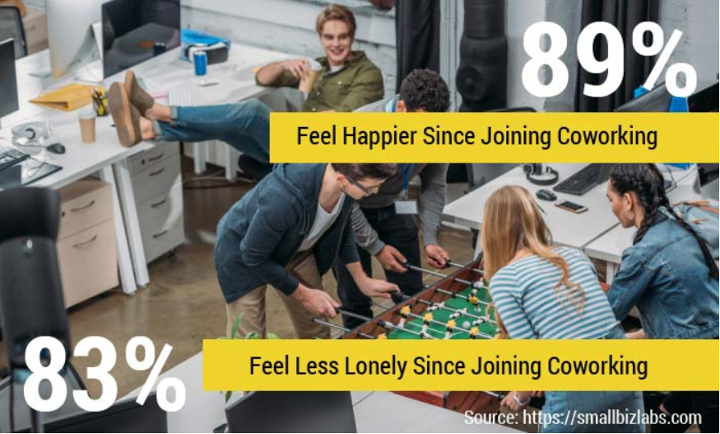
According to an extensive survey done in 2018, 89% of coworkers reported that they are happier since joining a coworking space, while 83% said that they feel less lonely.
86% of coworkers feel that they are part of a community when working in a coworking space, which corroborates with another study that says the majority of coworkers feel happier since joining.
Disadvantages of a coworking
Although there are lots of advantages to coworking, there are also some downsides. One of the biggest ones is the lack of privacy, a coworking space offers much less privacy compared to what a home office would provide. Without your own private office, completing all work within a public space may prove problematic, especially if you are dealing with confidential information. Competitors in the same building can listen to your team brainstorming sessions or phone calls, and steal your innovative ideas.
Offices can be noisy environments with keyboard tapping, phones ringing and employees talking. A noisy office can be a huge distraction for your teams which can make it hard for them to focus on their work. In fact, according to a survey by Clutch, 48% of people think that coworking is too noisy and distracting.
Coworking spaces are less suited to larger corporations that require more structure and space, it can be beneficial mostly for small businesses or freelancers . A large company would likely end up overspilling into communal areas on a regular basis which can be frustrating for other building members. Coworking solutions are often a temporary solution for businesses that grow really fast, they will need to relocate and find an appropriate office space to accommodate their growth.
In Conclusion
In most cases coworking seems to be the better option compared to home office. Statistics show coworking can lead to motivation, creativity, productivity improvement, can help you in finding new opportunities, you won’t feel lonely and you will be happier to belong to a community.
On the other hand, the widespread adoption of working from home since the pandemic has largely been successful, though employee burnout is an issue that cannot be ignored by either employees or their employers. Left unchecked, it can lead to a drop in employee productivity, mental health, and higher turnover rates. The decision between a coworking space vs. a home office is up to you and the type of business you conduct. Both have their positives and negatives, so it is important to think about each of them carefully and decide which type of environment will make you the most creative and productive.